

In 1 Samuel 13:14 NKJV (All scriptures cited in this article are from the NKJV.) Yahweh called David “a man after HIS heart” 1 Samuel 13:14 Why did he call him that? What sets David apart from all the prophets, priests, and kings in the Old Testament that led Yahweh to declare about a man who sinned just as we have sinned? Below are 7 points that show why David has this distinction over anyone else in scripture.

David’s faith: David first appears on the scene of Israel’s journey as a young man visiting his brothers fighting a war. The Philistines were determined to conquer Israel. They were thrashing them daily. Petrified, Saul is held up on one side of the valley while the massive giant of the Philistines taunts him and the army of Israel. David brought greets and food from his family for his brothers. David hears the taunts of Goliath, and the power of the Holy Spirit rises in him. HE declares, Before throwing the stone that would take the giant down, David tells the giant who everyone was afraid of…, “This entire assembly may know that the Lord does not save by sword or by spear; for the battle is the Lord’s, and He will hand you over to us!” 1 Samuel 17:47 He takes his slingshot and slings a stone at the giant, and the power of the Holy Spirit uses that slingshot to kill Goliath. The faith that brought down the giant, a testament to the power of belief, became the cornerstone of David’s life.

David’s Trust in Yahweh: David knew that Yahweh had chosen him to become the new king of Israel. At no time did he attempt to orchestrate events to make that happen. Even when David can kill Saul in a cave, “The Man After God’s Heart” does not do it. He revered and trusted Yahweh. 1 Sam. 24:12-13 tells us about that encounter. Saul did not understand why David did not take this opportunity to kill him. David’s response must have been chilling to Saul. “Let the Lord judge between you and me, and let the Lord avenge me on you. But my hand shall not be against you. As the proverb of the ancients says, ‘Wickedness proceeds from the wicked.’ But my hand shall not be against you.” David practiced what Jesus taught his followers in Matthew Matthew 5:44, “[a]But I say to you, love your enemies, bless those who curse you, do good to those who hate you, and pray for those who spitefully use you and persecute you,” I pray daily that I will respond in kind. When your enemy presses in, brothers and sisters, press into Jesus, the author and finisher of Your faith.

David was a humble servant of Yahweh. Although David demonstrated his God-given talent as a warrior king and was loved by his people, he never considered himself worthy of any special honor. When Saul offered his daughter Micah to David, he declared, “Does it seem to you a light thing to be a king’s son-in-law, seeing I am a poor and lightly esteemed man?” 1 Sam. 18:23 Even after David became king and Nathan the prophet told him that Yahweh intended to extend his dynasty forever, King David was baffled and humbled. In his prayer to thank Yahweh for that distinction, he said. “Then King David went in and sat before the Lord; and he said: “Who am I, O Lord God? And what is my house, that You have brought me this far?” 2 Sam. 7:18
David’s Integrity before Yahweh: While David and his men were fleeing from Saul, they were ravished, and when David arrived in the City of Nob, he lied to the Ahimelech, the priest, and convinced him to allow him to get food from the city for his men. Saul came to the city looking for David, and Ahimelech admitted to feeding David and his men. Saul slaughters the priest and all of the people in the town except for one person who runs to David for shelter. When he tells David what happened, David admits that he is the reason why Saul slaughters the man’s relatives. David took him in and cared for him. 1 Sam. 22:9-19 However, in the story of Bathsheba, we learn about David’s terrible sin. To cover up his sin of adultery, he planned and executed the death of Uriah – Bathsheba’s husband. 2 Samuel 11:14-16 Yahweh sent Nathan the prophet to declare to David that He knew what David had done and what the consequences of his actions would be. David didn’t make excuses for his behavior. He took ownership of what he had done and repented of it. “So David said to Nathan, “I have sinned against the Lord.” 2 Sam. 12: 13
David Worships Yahweh
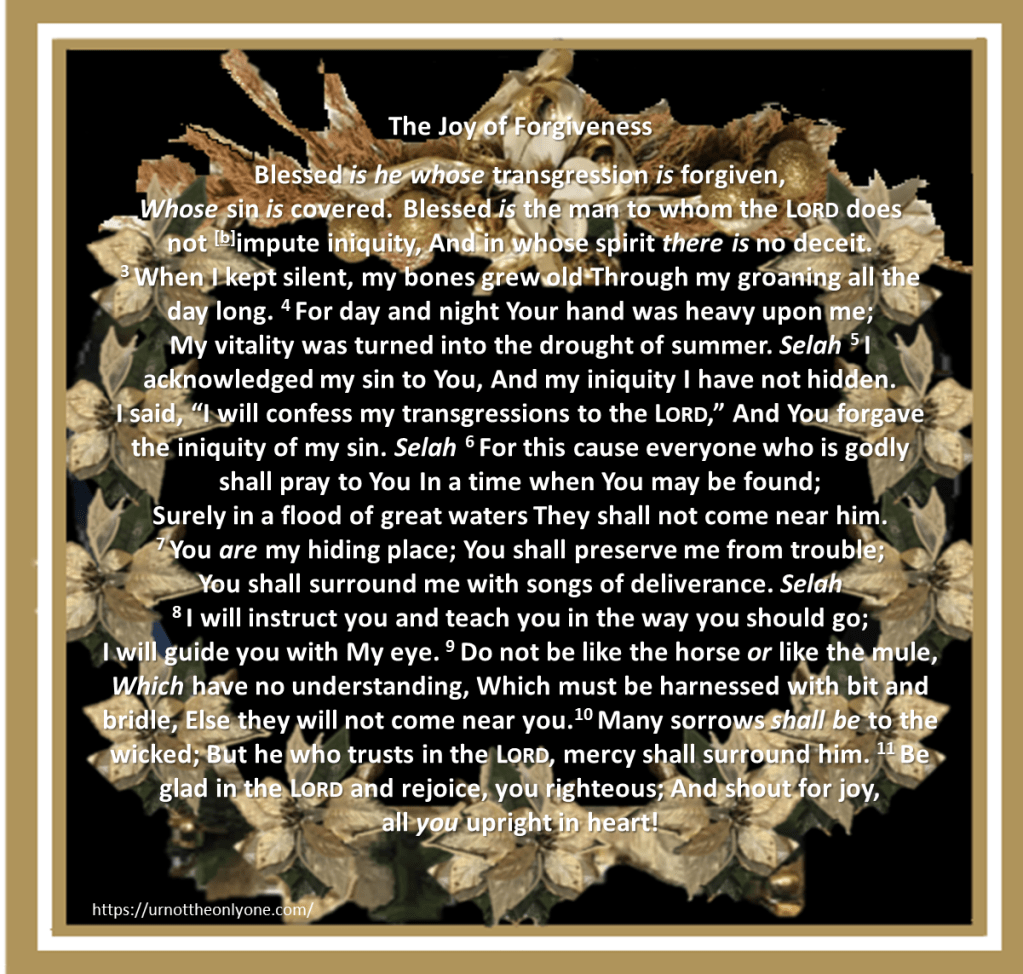
His prayer of repentance is codified in one of the most beautiful Psalms ever written- Psalm 51. Even though David had sinned, he never stopped praising Yahweh for the “Joy of forgiveness” he received when he prayed the prayer codified in Psalm 32. Theologians believe that Psalm 32 was written at the same time as Psalm 51.




 You Are Not the Only One
You must be logged in to post a comment.