
Revised Common Lectionary Sermon Outline for June 15, 2025 – Trinity Sunday
Psalm 8:1–9 · Proverbs 8:1–4, 22–31 · Romans 5:1–5 · John 16:12–15
Today is the first Sunday after Pentecost, also known as Trinity Sunday.
We’re celebrating the union of God and people and all of creation. The
Byzantine monk, Symeon the New Theologian, summed up Trinity Sunday’s
purpose by saying that the Holy Trinity encompasses humanity and binds
us together, influencing the way we relate to God and each other. Our
weekly theme is God Is Father, Son, and Spirit with readings focused on
the mystery of the Trinity.
This theme is reflected in our call to worship, Psalm 8, asking in awe
about the purpose of humanity in relationship with God. It acknowledges
the honor bestowed on human beings and wonders, “What are [human beings]
that you should be mindful of [them]?” Proverbs 8 emphasizes our access
to Wisdom, personified in Proverbs as a woman (Proverbs 1:20-21), the
first of God’s creations.

Romans 5:1–5 discusses the life-giving,
empowering nature of our relationship within the Holy Trinity and the
way it impacts everything about us. Our sermon text, found in John
16:12–15, takes us back again to the Upper Room after the Last Supper.
We’ll learn how Jesus’ farewell discourse prepared the disciples for the
confusion they were going to be facing in the near future by affirming
that not knowing or understanding everything was OK.
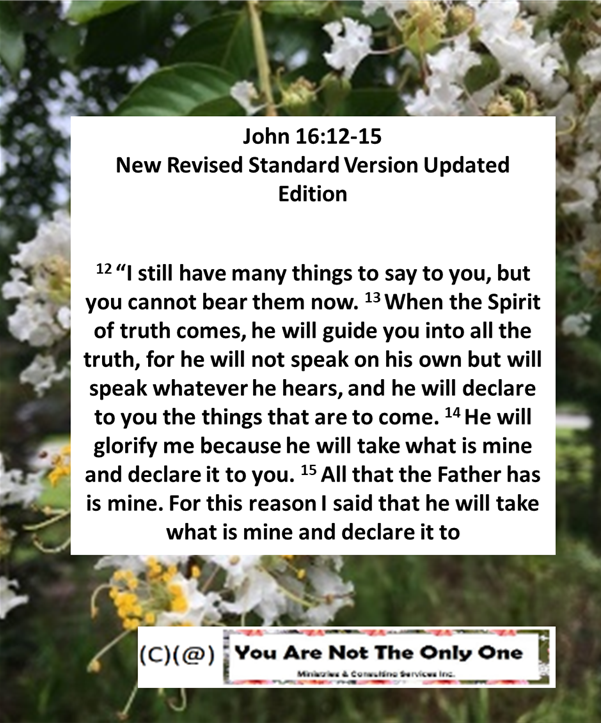
Don’t Know? No Problem! John 16:12–15 NRSVUE
In the US, we have several clichés for not understanding something. See
if you’ve heard any of these:
“That’s as clear as mud.” “It’s going over my head.” “It’s not clicking.” “It doesn’t compute.” “I can’t make head or tails of it.” Most of them are funny. Have you ever made a joke when something didn’t make sense to you? It feels uncomfortable not to understand, so we may attempt a joke. But when we don’t understand, it can be a little scary. If you’ve ever traveled in a foreign country without knowing the native language, you’ve experienced the unsettling nature of being unsure what the signs say, what train to take, or where to get off public transit.
It can cause you to feel disoriented and vulnerable.
Our sermon text on this Trinity Sunday helps us understand that it’s OK not to know for sure what’s next. It’s OK to be vulnerable. We’ll learn how prayer is more like a divine, joy-filled dialogue than a holy download, and how the Persons of the Trinity can comfort us at different points in our Christian journey. Let’s read John 16:12–15 together.
Context of John’s gospel
It’s important to consider that the four Gospels present different aspects of Jesus’ ministry, using Jesus’ experiences and life to convey what God’s salvation is for us, rather than trying to harmonize the
Gospels. Dr. Jennifer Garcia Bashaw, Associate Professor of New Testament and Christian Ministry at Campbell University, in a podcast, The Bible for Normal People, suggested that we can gain “a more nuanced
and comprehensive picture of salvation” by noting each gospel’s unique contribution.
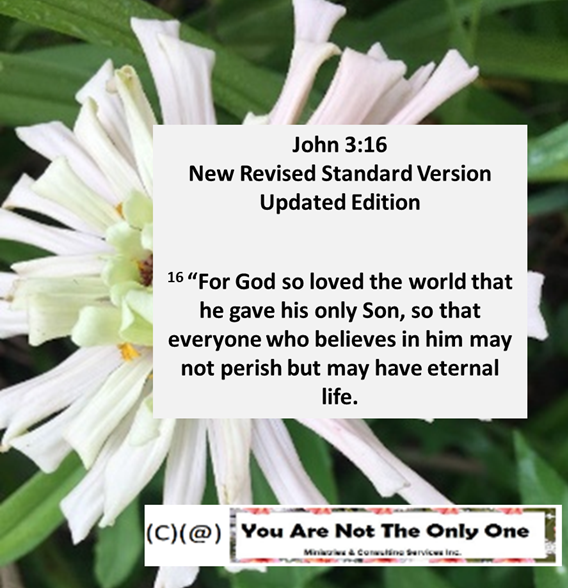
For example, we typically take John 3:16 out of context to persuade people that “God loved us and sacrificed Jesus for us and if we just believe, we can go to heaven” (Bashaw). To Bashaw, using John’s word in
this manner doesn’t fully do justice to the symbolism we find in John’s gospel. She asserts that while John does write about the love of God, he doesn’t confine his discussion of eternal life to be in the future after
we die. Instead, Bashaw argues that “the emphasis John places on belief is … more experiential than intellectual: belief in Jesus manifests in love and results in following Jesus and experiencing the love of God
through him and the Spirit.”
We can miss the significance of the cross and crucifixion in John’s Gospel. Jesus lays his life down as the Passover lamb; this is the ultimate atoning sacrifice. In laying down his life, Jesus is revealing
more about himself as our Redeemer. John’s purpose in his Gospel is to reveal the truth about who Jesus is. Jesus’ life, ministry, and death are all part of his identity, and reveal who God is. The cross is the
ultimate victory. Bashaw calls it Jesus’ “glorification, a victory that is the ultimate expression of his love for God and for ‘his own’ as well as a beacon showing God’s love for the world.”
As we review chapters 13–17 in John, we can see that love is the overarching theme. John 13 talks about Jesus’ love for his disciples and his new command to love others as he had loved them.
- John 14 discusses the gift of the Spirit and its connection to love,
- while John 15 offers the metaphor of the vine and the branches as a means of illustrating love’s flow.
- John 17 concludes with the story of divine love in the world coming to life through believers everywhere.
From this context, we can consider Jesus’ farewell discourse in chapter 16 as a means of encouraging the disciples to love and to trust the process of prayer and discernment because the presence of the Holy
Spirit would guide them. At this eleventh hour, Jesus wanted to reassure them that God would always be with them, despite any challenges they faced. Jesus wasn’t offering certainty but presence always. Let’s think
about the vulnerability of uncertainty, the dialogue of prayer, and the comfort we gain from each of the three Persons of the Trinity.
The vulnerability of uncertainty
Jesus told the disciples that he had lots to share with them in their remaining short time together, but they could not handle it (John 16:12). Grief was clouding their ability to comprehend, and Jesus knew
that. So, he encouraged them by saying in essence, “It’s OK not to know everything right now.”
In fact, we find ourselves in a predicament similar to the disciples. We can’t comprehend God’s presence or position in a world where much seems to have gone awry. It’s scary to be vulnerable and to live within the
confines of impermanence and uncertainty. However, like the disciples, we’re not left to ourselves. Jesus says the Spirit of Truth accompanies us through whatever we’re facing. Let’s read the next two passages from
The Message Bible:
I still have many things to tell you, but you can’t handle them now. But when the Friend comes, the Spirit of the Truth, he will take you by the hand and guide you into all the truth there is. He won’t draw attention
to himself, but will make sense out of what is about to happen and, indeed, out of all that I have done and said. John 16:12–13 The Message
This implies a life of slow growth, not knowing everything all at once but insight being revealed as needed. This type of wisdom is based on our concrete experiences in our unique cultural and historical context.
This means that while the basic wisdom remains the same, its expression and guidance might differ from generation to generation or culture to culture. This is where we trust the mystery of God’s goodness and presence.
The Dialogue of Prayer
Perhaps when we worry about praying “effectively,” we’ve turned to formulas as a means to create outcomes rather than attending to our relationship with the Divine. John 16:13–15 explains how the Spirit
conveys the hearts of God the Father and Jesus: But when the Friend comes, the Spirit of the Truth, he will take you by the hand and guide you into all the truth there is. He won’t draw attention to himself, but will make sense out of what is about to happen and, indeed, out of all that I have done and said. He will honor me; he
will take from me and deliver it to you. Everything the Father has is also mine. That is why I’ve said, “He takes from me and delivers to you.” John 16:13–15 The Message
Notice that the Holy Spirit works within our context, “mak[ing] sense out of what is about to happen” (v. 13). This makes the guidance and comfort relevant to us, not obscure. Prayer becomes a dialogue between
Father, Son, and Spirit, and us. Being in this continual dialogue makes our conversation with God fluid and kind and present to what is going on in our world.
There’s an old story about a bishop of a large territory who decided to visit every single parish. This took place before planes and automobiles, and he had to travel on horseback, so it took a number of years. He thought he had visited all of them until someone mentioned a small chapel that was on a remote island. He used a boat to reach the island, and when he got there, he found that it was inhabited only by three old men. The bishop greeted the men and began to talk to them about their faith. “Tell me about how you pray,” he asked them.
And the old men replied, “We stand together, hold hands like this, and then we say, ‘You are three; we are three; have mercy on us.’ ” “Oh, no, that won’t do,” the bishop said. “Don’t you know the Lord’s prayer?” “No, we don’t,” the men said. “Teach it to us.” The bishop complied and taught them the prayer, and then he said goodbye and left on his boat. As he headed back to the mainland, he noticed a spark of light coming across the water from the island he had just left. As it drew closer, he could see it was the three hermits. They were holding hands and running across the top of the water. “Dear bishop,” they cried, “we’ve forgotten the Lord’s prayer. Can you teach us again so we can pray effectively?” “Never mind,” the bishop told them. “I think your version of prayer is
working just fine.”
This story illustrates that rather than formulas and special wording, prayer is intended to be a dialogue, and often dialogue means listening more than speaking. Listening is an invitation for mystery and not
knowing. It’s an invitation to trust and abide in the true Vine, in Love. And that’s enough.
Comfort from the Trinity
Each Person of the Trinity offers us the opportunity for comfort and to feel known. For example, we can catch a glimpse of the love God the Father has for us through our own experiences of parenthood, loving
another person, or loving a pet. We can better understand and be comforted when we suffer by reflecting on Jesus’ suffering, knowing he empathizes with us because he suffered pain, too. We can be inspired
through Jesus’ example to love those whom we might not choose to love on our own. Through the Holy Spirit, we participate in bringing the dream of God to reality on earth as we ask for and listen to the Divine
guidance. We can’t yet know everything that we must do or go through in the future; it is too much for us to bear. We need the Spirit of Truth to guide and carry the burdens we will face one step at a time.
We see Jesus using the word “bear” in John 16:12: I still have many things to say to you, but you cannot bear them now. John 16:12 NRSVUE
The same word for “bear” is used in other parts of the New Testament, usually referring to the ability to bear a physical weight. For example, it is used in John 19:17 to refer to Jesus bearing the cross, and again
when Mary Magdalene mistakes Jesus for the gardener and asks where he has taken (borne or carried) Jesus’ body (John 20:15). Jesus was reassuring the disciples that even though they couldn’t accept what he
needed to tell them or about the events that were soon to happen, the Spirit of Truth would be able to bear it for them and give them the guidance they needed when they needed it. The Spirit does that for us
today, too.
While Western tradition usually demonstrates the Trinity with the illustration of a triangle, the Eastern tradition has typically used a circle to convey the flow or dance of the three Persons of God. Theologian Scott Hoezee puts it this way: “The Father pours out everything onto the Son. The Spirit then takes all that from the Son to
pour out these riches on all other people. Each person in God exudes enthusiasm for the other two (and the three together display a zestful enthusiasm for us all).”
On this Trinity Sunday, we can celebrate the dance of love by the holy Trinity: the Father, Son, and Holy Spirit, knowing that we don’t have to bear the uncertainty of things we cannot handle alone. We have the
Spirit of Truth, the Cosmic Christ, and God the Father loving us and guiding us all home.
Call to Action: Pray this week’s Collect (a short prayer) from the Book of Common Prayer shown below and invite the triune God to reveal the beauty of their triune love to you.
Almighty and everlasting God, you have given to us your servants grace, by the confession of a true faith, to acknowledge the glory of the eternal Trinity, and in the power of your divine Majesty to worship the
Unity; Keep us steadfast in this faith and worship, and bring us at last to see you in your one and eternal glory. O Father; who with the Son and the Holy Spirit live and reign, one God, for ever and ever. Amen.
For Reference:
Small Group Discussion Questions
Human beings crave certainty, and we don’t like feeling vulnerable. Can
you imagine the way the disciples might have been feeling in the upper
room after Jesus explained the events that would soon take place? Can
you share a personal experience where you felt uncertain and vulnerable,
unsure of the next step?
The sermon suggests that the Holy Spirit reveals guidance to us as we
need to know it. Do you agree? Have you experienced this?
What are your thoughts about prayer as a dialogue that involves mostly
listening? What experiences have you had with this modality of prayer?
Have you ever considered how the different Persons of the Trinity can
provide comfort because we can connect with them each differently?
© Copyright 2025 Grace Communion International





 You Are Not the Only One
You must be logged in to post a comment.